
Best via ferratas in Lombardy: 9 routes from easy to hard
Panorama editorial team · Published · Updated
Editorial selection based on public route descriptions (CAI sections, tourist boards, specialist websites), with the key data cross-checked against at least two sources per via ferrata. Where sources disagree we give a range. Times and elevation gain are approximate.
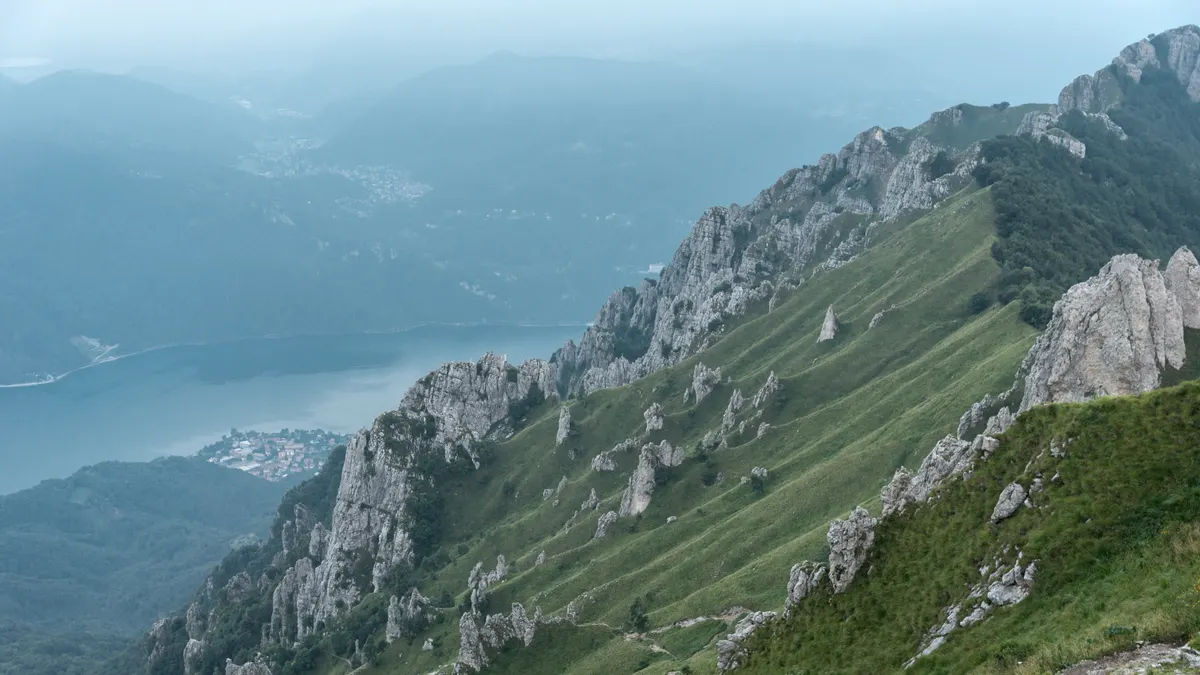
The best via ferratas in Lombardy are clustered around Lecco and Lake Como: Gamma 1 on the Pizzo d’Erna, Medale, Gamma 2 on the Resegone, the Monte Grona via ferrata and the Venticinquennale on the Corni di Canzo. For beginners there are easier routes such as the Ferrata Sasse on Lake Idro, the Ferrata della Porta on the Presolana and the Sasso dei Carbonari ridge on the Grigna.
Below are nine via ferratas picked for variety and difficulty, with the key facts to help you work out which one suits you. They are not the only ones: Lombardy has dozens, from the Valchiavenna to the province of Brescia.
How to read the grades
We use the same scale for every route, the one Gulliver uses for via ferratas: F (easy), PD (moderately easy), AD (fairly difficult), D (difficult), TD (very difficult). Other sources use different scales (for example EEA followed by a grade, or the A-E scale), so when a website rates a route higher or lower we point it out.
The grade describes the technical moves, not the effort. An F route with 1,000 m of elevation gain and a long walk out can be more tiring than a short D.
What are the best via ferratas in Lombardy?
| Via ferrata | Area | Grade | Elevation gain | Total time | Best season |
|---|---|---|---|---|---|
| Sasse | Lake Idro (BS) | PD (mostly F) | about 250-300 m total | about 3.5 h | spring, autumn |
| Ferrata della Porta | Presolana, Colere (BG) | F | about 900 m to the hut + about 450 m on the loop | 2 days or a very long day | June to October |
| CAI Mandello on the Sasso dei Carbonari | Grigna Settentrionale (LC) | PD | about 1,000 m total | 6-8 h | June to October |
| Gamma 1 | Pizzo d’Erna, Lecco | PD (D in other sources) | about 575-600 m total | 3-4 h | spring, autumn |
| Mario Minonzio | Zuccone Campelli, Valsassina (LC) | AD | about 680 m total | 5.5-6 h | June to October |
| Centenario CAO | Monte Grona, Lake Como (CO) | D | about 650-735 m total | 5-6 h | spring to autumn |
| Venticinquennale CAI | Corno Occidentale di Canzo (CO) | D | about 900 m total | about 4 h | spring, autumn |
| Medale (degli Alpini) | Corno Medale, Lecco | D | about 600-700 m total | 3.5-4 h | spring, autumn |
| Gamma 2 | Resegone, Lecco | TD | about 600 m of via ferrata + approach | about 4 h from the Piani d’Erna | June to October |
Times are those given in the route descriptions we used, for a fit hiker with no queues. With a large group or on fine weekends, especially on the Lecco routes, allow more.
What is the easiest via ferrata in Lombardy for beginners?
Ferrata Sasse, Lake Idro
Area: eastern shore of Lake Idro, province of Brescia. Start: the hamlet of Vesta, car park near the beach. Grade: PD, mostly F with a few trickier moves.
From the car park a path leads to the start in about 20 minutes. The route traverses the hillside above the lake, with a footbridge and a short vertical wall with plenty of rungs. According to Gulliver it takes about 1 h 45 to the road near Baitoni, and the return along the “smugglers’ path” takes about 1 h 20. The elevation gain is modest, in the region of 250-300 m.
Why go: it is low (between about 370 and 515 m), short and very scenic, ideal for a first outing with your own kit. Watch out: the ground is often earthy and loose, especially on the first downhill section. Summer is hot, so spring and autumn are better.
Ferrata della Porta, Presolana
Area: Presolana group, Colere, Val di Scalve (BG). Start: Colere, walking up to the Rifugio Albani (1,939 m). Grade: F.
The via ferrata itself is short: metal ladders and cables lead from the Colle della Guaita towards the Passo della Porta and Monte Visolo (about 2,370 m). The hard part is everything around it: reaching the Rifugio Albani from the Carbonera di Colere takes about 900 m of elevation gain and 2-2.5 h. The full loop suggested by CAI Parma, from the hut to the Visolo and down to the Passo della Presolana, is estimated at about 7 hours.
Why go: stern high-mountain terrain beneath the Presolana walls, with low technical difficulty. It works well as a weekend with a night in the hut. Watch out: north-facing, above 2,000 m, with snow possible early in the season. Plan your return carefully, as the start and finish may not be in the same place.
Ferrata CAI Mandello on the Sasso dei Carbonari, Grigna Settentrionale
Area: Grignone, above Lake Como (LC). Start: Cainallo, at the end of the road from Esino Lario. Grade: PD.
From Cainallo it takes about 1 h 30 to climb to the Rifugio Bietti, then about 30 minutes to the start. The route follows the long ridge of the Sasso dei Carbonari to the Bocchetta di Releccio, from where you can climb to the summit of the Grignone (2,409 m) and descend via the Rifugio Bogani to Cainallo. Total elevation gain is around 1,000 m and the day takes 6-8 hours depending on the source.
Why go: Gulliver describes it as “long but not difficult”, with views over the lake, the Grigne and the Alps. Watch out: the effort is real and the ridge is fully exposed to the weather. In early summer and autumn there may be snow or ice, especially on the descent.
Which Lecco via ferratas should you not miss?
Lecco is Lombardy’s via ferrata capital: the walls of the Resegone, Pizzo d’Erna and Medale are a few minutes from town. If you want to compare this style with the Western Alps, take a look at the best via ferratas in Piedmont too.
Gamma 1, Pizzo d’Erna
Area: Pizzo d’Erna, Resegone, Lecco. Start: car park at the Piani d’Erna cable car, Versasio. Grade: PD according to Gulliver; other sources, including some CAI programmes, rate it D.
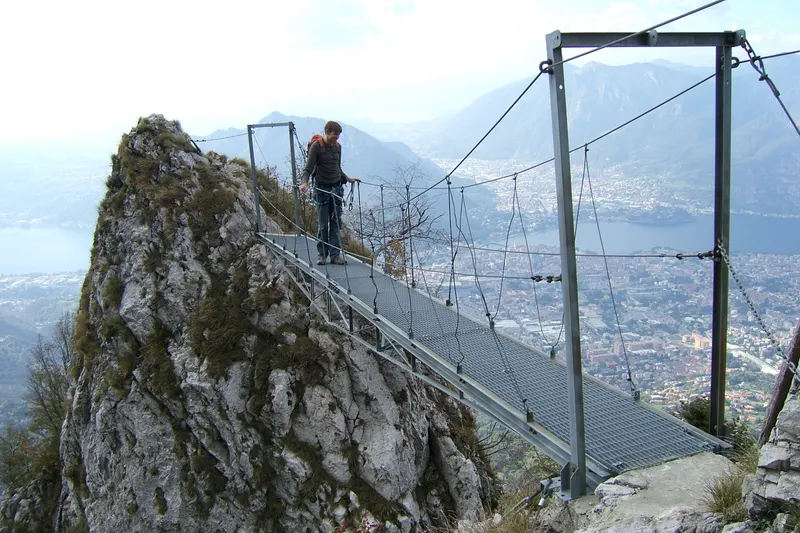
From the car park, follow path 1 for about 20-25 minutes, then branch left towards the start. The via ferrata has about 575-600 m of elevation gain and route descriptions give 3-3.5 hours to the top. The descent is on foot to Versasio or, when it is running, by cable car from the Piani d’Erna. Near the top there is a suspension bridge with views over Lecco.
Why go: this is Lecco’s signature via ferrata, varied, with lots of ladders and an escape route to the Rifugio Stoppani after the first section. Watch out: the first section is very exposed, and the route has been closed several times over the years for maintenance and inspections. Check its current status before you go.

Ferrata del Medale (degli Alpini)
Area: Corno Medale, Lecco. Start: Rancio di Lecco, car park near the cemetery, then follow signs for the via ferrata. Grade: D.
The approach is short, about 30-40 minutes on steep tarmac and path. The via ferrata takes about 2 hours to the summit, with the descent via the Cappella di San Martino and the Rifugio Piazza. Total elevation gain is about 600-700 m according to CAI Bergamo and SummitPost, for 3.5-4 hours in all.
Why go: a vertical wall right above the town and the lake, with corners, slabs and chimneys. Watch out: Gulliver calls it “very exposed and tiring”. The hardest part is the first half, and there is loose rock on the final section. It faces south-east: in summer the rock is scorching by mid-morning.
Gamma 2, Resegone
Area: Resegone, Lecco. Start: Piani d’Erna, reached by cable car or on foot from Versasio. Grade: TD.
From the Piani d’Erna you reach the start in about 30 minutes. The route climbs about 600 m of vertical height to the Dente del Resegone, on chains and a few pegs, with no ladders. The Lecco tourist board gives about 4 hours of walking in total. To get back, take path 10 and descend the Canalone Bobbio to the Piani d’Erna, or go over the summit of the Resegone.
Why go: it is one of the most demanding via ferratas in the Prealps, close to a rock climb. Watch out: there are no escape routes and retreating is not advised; the crux is a very technical vertical chimney. Only for people who already have D and TD via ferratas under their belt.
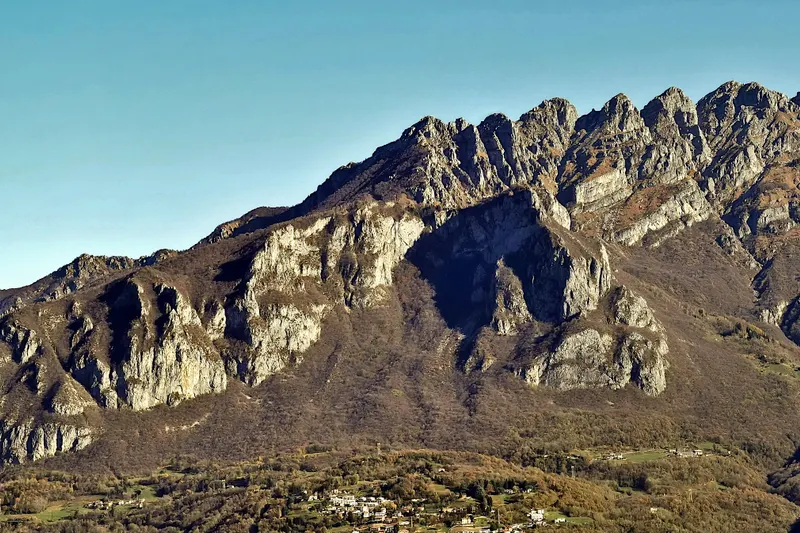

Which via ferratas to do on Lake Como and in the Valsassina?
Ferrata del Centenario CAO, Monte Grona
Area: Monte Grona, above Menaggio (CO). Start: Monti di Breglia, from Menaggio via Plesio; the last car park is pay and display. Grade: D (CAI Varese gives D-).
From the car park it takes about 1 hour to the Rifugio Menaggio, then about 20 minutes to the start. The route climbs over a series of towers to the summit (1,736 m), and the difficulty stays fairly consistent. CAI Varese estimates about 3.5-4 hours up and 1.5-2 hours down, with total elevation gain of about 735 m.
Why go: the view over Lake Como is one of the finest in the region, and there are two marked escape routes, halfway and three quarters of the way up. Watch out: some climbing ability (grade II-III) is recommended. In spring 2026 it was closed for a few weeks while the cable was replaced: a good example of why it always pays to check.
Ferrata del Venticinquennale CAI, Corno Occidentale di Canzo
Area: Corni di Canzo, Triangolo Lariano (CO). Start: Fonti di Gajum (485 m), above Canzo. Grade: D.
You walk up past the Rifugio Terz’Alpe to the start in about 2 hours. The via ferrata takes about 1 hour and finishes at the cross on the Corno Occidentale (1,373 m). A few minutes’ walk takes you down to the SEV hut, then path 1 leads back to Gajum. About 4 hours in total according to the route descriptions we used, for almost 900 m of elevation gain from the car park.
Why go: short but intense, an hour from Milan. Watch out: the hardest move is an exposed vertical slab with few holds right at the start, followed by a slightly overhanging ladder of about 12 m. The Passo della Vacca gets tricky with snow or ice.
Ferrata Mario Minonzio, Zuccone Campelli
Area: Zuccone Campelli, Piani di Bobbio and Artavaggio, Valsassina (LC). Start: top station of the Artavaggio cable car (1,600 m) from Moggio, or from the Piani di Bobbio. Grade: AD (CAI Gazzada Schianno rates it moderately difficult).
The CAI Gazzada Schianno route description gives 680 m of ascent and 5.5-6 hours for the loop from Artavaggio, passing the Rifugio Lecco and climbing the Valle dei Camosci. The via ferrata follows an up-and-down ridge to the Dente dei Campelli (2,173 m). The descent is by the normal route towards the Cazzaniga-Merlini and Nicola huts.
Why go: a very scenic ridge with a Dolomite feel, a stone’s throw from the plain. Watch out: the crux is a long gully taken in descent, with rock that is loose in places. The Canalone dei Camosci can hold snow until late spring. If you use the cable car, check the time of the last ride down.
When is via ferrata season in Lombardy?
It depends on altitude and aspect. The low, sunny routes (Medale, Gamma 1, Canzo, Sasse) are at their best in spring and autumn. In summer the heat on south-facing walls is punishing, so start at dawn.
The routes above 2,000 m (Minonzio, Sasso dei Carbonari, Porta) are for late June to early October, but snow can linger in north-facing gullies. In winter via ferratas are not hiking terrain: snow and ice change the difficulty completely.
Weather and thunderstorms
In the Lombardy Prealps, summer storms often build in the early afternoon. On a via ferrata the steel cable attracts lightning, and a ridge like the Sasso dei Carbonari offers no shelter. Start early, check the ARPA Lombardia forecast and turn back if storms are on the cards.
On wet rock even an easy via ferrata gets slippery. The limestone of the Grigne and the Resegone, polished by countless feet, even more so.
What kit do you need for a via ferrata?
The minimum kit, even on F routes:
- Certified climbing helmet: protects against rockfall, which is common on busy routes.
- Climbing harness, adjusted to your size.
- Certified EN 958 via ferrata set, with an energy absorber and two arms with karabiners. Check the manufacture date and any manufacturer recalls.
- Via ferrata gloves, handy on cables and chains.
- Boots or approach shoes with a stiff sole, water, windproof jacket, head torch, charged phone.
Do not use homemade slings instead of a proper set: they will not absorb the energy of a fall. If you do not have the kit, ask a mountain guide or a specialist shop whether you can hire it.
How to choose the right via ferrata for your level?
If you have never done a via ferrata, start with Sasse or the Ferrata della Porta, or go out with a mountain guide. You will learn to clip and unclip your karabiners, move on exposed ground and find out how you handle the drop.
After a few outings you can step up to PD and AD routes such as Gamma 1, Sasso dei Carbonari or Minonzio. The D routes (Medale, Grona, Canzo) need strong arms and confidence on easy rock. Gamma 2 is in a league of its own.
Also consider:
- Total length and elevation gain, not just the equipped section.
- Escape routes: Gamma 1 and Grona have them, Gamma 2 does not.
- The way back: often the most underestimated part. Steep gullies, scree, cable cars with timetables: plan the return before you set off.
If you want to compare with more Dolomite-style terrain, we have also put together the best via ferratas in Trentino.
Via ferrata risks: what to check before you go
No via ferrata is free of risk, not even the F routes. Conditions change every season: rockfall, damaged cables, broken anchors. Routes can be closed by a council order or by their managers for maintenance, as happened on Gamma 1 and Monte Grona.
Before you set off:
- check the state of the route with the local CAI section, the tourist office or a mountain guide;
- read recent trip reports, but remember they describe conditions on one particular day;
- tell someone your route and when you expect to be back;
- install and switch on GeoResQ, the location service run by the CAI and the Italian Alpine Rescue.
In an accident, call 112. If you can, stay clipped to the cable and give the most precise location you have.
Planning your days out
A good day on a via ferrata starts with preparation: an up-to-date route description, the forecast, cable car times, a plan B. At Panorama we are building an iPhone app for people who love via ferratas and bivouac huts, to bring this information together in one place. In the meantime you will find more guides in all the blog guides.
Sources
- Gulliver: via ferratas in Lombardy (list and route cards)
- Gulliver: Gamma 1 on the Pizzo d’Erna
- Gulliver: Gamma 2 on the Resegone
- Gulliver: Ferrata degli Alpini on the Medale
- Gulliver: Ferrata del Centenario CAO on Monte Grona
- Gulliver: Via Mario Minonzio on the Zuccone Campelli
- Gulliver: Ferrata della Porta on Monte Visolo
- Gulliver: Ferrata Sasse on Lake Idro
- Gulliver: Ferrata CAI Mandello on the Sasso dei Carbonari
- Gulliver: Ferrata del Venticinquennale on the Corni di Canzo
- Lecco Tourism: Ferrata Gamma 1
- Lecco Tourism: Ferrata Gamma 2
- inalto.org: Ferrata Gamma 1 on the Pizzo d’Erna
- inalto.org: Via ferrata CAI Mandello
- CAI Bergamo: Ferrata del Medale
- CAI Bergamo: Ferrata Sasse and Monte Calva
- CAI Varese: Ferrata del Centenario on Monte Grona
- CAI Gazzada Schianno: Ferrata Mario Minonzio
- CAI Verona: Ferrata del Venticinquennale
- CAI Parma: programme with the Ferrata della Porta and Monte Visolo
- SummitPost: Via Ferrata del Medale
- Climbing.place: Ferrata del Venticinquennale
- Montagna.tv: closure of the Gamma 1 and Gamma 2 via ferratas
- Planetmountain: Monte Grona via ferrata closed for works
- GeoResQ, the CAI location service

Panorama, the app for mountain lovers
Panorama is an upcoming iPhone app for via ferratas and bivouac huts. See how it will work and what you will be able to save for your next days out.
Discover Panorama Panorama Sci, free on iPhone and Android.Panorama Sci app · free


FAQ
What is the easiest via ferrata in Lombardy?
Among the easiest are the Ferrata Sasse on Lake Idro, mostly F with a few PD sections, and the Ferrata della Porta on Monte Visolo, graded F. The first is low and short; the second is technically easy but has a long approach at altitude. You still need full kit and steady footing.
What is the hardest via ferrata around Lecco?
Gamma 2 on the Resegone is considered the most demanding route in the Lecco area: Gulliver grades it TD and the Lecco tourist board EEA-TD. It has vertical sections, a technical chimney and no escape routes. It is only for people who already have climbing experience and hard via ferratas behind them.
Can beginners do Gamma 1?
Gamma 1 is often the first "real" via ferrata for Lecco locals, but it is exposed and has around 600 m of elevation gain. Gulliver grades it PD, other sources rate it harder. If you have never done a via ferrata, go with a mountain guide or with experienced friends, and check the state of the fixtures before you set off.
When is the best time for via ferratas in Lombardy?
Low, sunny routes such as Medale, Gamma 1 or Sasse are best in spring and autumn; in summer they get very hot. Those above 2,000 m, such as Minonzio, Sasso dei Carbonari or Ferrata della Porta, are for June to October, with leftover snow possible early in the season.
Do I need a certified via ferrata set even on easy routes?
Yes. Even an F-graded via ferrata calls for a helmet, harness and a via ferrata set with an energy absorber meeting the EN 958 standard. A makeshift sling will not absorb the energy of a fall. Gloves help a lot on cables and chains.
Do the Lecco via ferratas use cable or chain?
Several routes around Lecco, such as Gamma 2 and Medale, are equipped largely with chains as well as cables, ladders and pegs. It is worth knowing before you go: your grip and the way you move are different from a taut cable.
What should I do if there is an accident on a via ferrata?
Call 112, the single emergency number, and give your location as precisely as you can. If you have GeoResQ installed, the app run by the CAI and the Italian Alpine Rescue service, switch it on before you start: it lets you send your position to the rescue team.