
Best via ferratas in Trentino: 10 to do at least once
Panorama editorial team · Published · Updated
Editorial selection based on public route descriptions (Visit Trentino, Garda Trentino, local authorities, Planetmountain, specialist websites and guidebooks), with the key figures for each via ferrata checked against at least two sources. Times and elevation gain are indicative and may change.
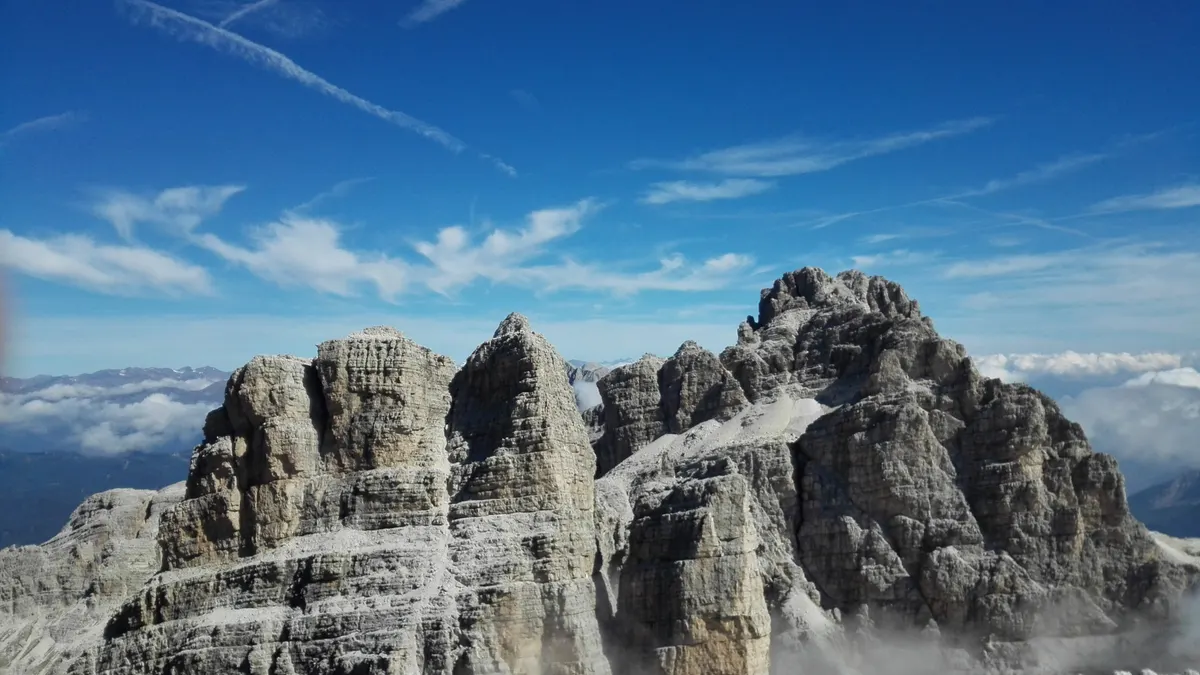
The best via ferratas in Trentino are the Sentiero delle Bocchette in the Brenta, the Ferrata delle Aquile on the Paganella, the routes around Arco and in the Valle dei Laghi (Colodri, Rio Sallagoni, Rino Pisetta, Che Guevara), the Colac in Val di Fassa and the Bolver-Lugli on the Pale di San Martino. To get started, pick Colodri or Rio Sallagoni in spring or autumn. For the high routes, wait for midsummer and check snowfields and openings.
This guide covers ten via ferratas, all in Trentino, with a comparison table and a profile for each one. We have left out routes in South Tyrol and the Veneto, even those right on the border.
Which are the best via ferratas in Trentino?
The table sums up the key figures. Sources do not always agree: where the numbers differ, we give a range or an indicative value.
Grading scale used. Every source uses a different scale (EEA, A-E, “easy/moderate/difficult”). To compare them, we converted everything to the Italian alpine scale: F (easy), PD (slightly difficult), D (difficult), MD (very difficult). This is our editorial summary, not an official grade.
| Via ferrata | Area | Grade | Elevation gain | Total time | Best season |
|---|---|---|---|---|---|
| Monte Colodri | Arco, Garda Trentino | F | about 280-300 m in total | 2-3 h | all year, best in spring and autumn |
| Rio Sallagoni | Drena, Garda Trentino | PD | about 200 m in total | 1.5-2.5 h | spring and autumn |
| Burrone Giovanelli | Mezzocorona, Piana Rotaliana | PD | about 700-850 m in total (loop) | about 5 h | spring and autumn |
| Ferrata delle Aquile | Paganella | D | about 280-350 m (via ferrata) | 4-5 h with approach | summer, when the lifts run |
| Bocchette Centrali | Brenta Dolomites | PD | about 400 m (via ferrata), 1,100-1,300 m from Vallesinella | 4-4.5 h on the via ferrata, up to 9 h as a day trip | mid June to September |
| Bocchette Alte | Brenta Dolomites | D | about 500 m (via ferrata), 700-1,200 m in total | 4-5 h from Rifugio Tuckett | July to September |
| Ferrata dei Finanzieri | Colac, Val di Fassa | D | about 450 m (via ferrata), 575-600 m in total | 4-4.5 h | July to September |
| Bolver-Lugli | Cimon della Pala, Pale di San Martino | D | about 1,000 m in total | 6-9 h | July to September |
| Rino Pisetta | Monte Garzolet, Valle dei Laghi | MD | about 400 m (via ferrata), 700 m in total | 5-6.5 h | spring and autumn |
| Che Guevara | Monte Casale, Valle dei Laghi | D | about 1,200 m (via ferrata), over 1,400 m in total | about 8 h | spring and autumn |
Which is the easiest via ferrata in Trentino for beginners?
The best via ferratas for beginners are around Arco and Dro: low, close to the car and with a short descent. They are still vertical routes, with possible rockfall and exposed sections.
Monte Colodri via ferrata (Arco)
Area and start: Arco. You start in the Prabi area, on the path opposite the municipal swimming pool car park. Alternatively, park at Caneve, a few minutes from the centre.
Grade: F. Sources describe it as easy or moderate, also suitable for beginners with someone experienced.
Elevation gain and times: about 280-300 m, 2 hours according to Visit Trentino, up to 3 hours with breaks and the descent.
Season: all year, but in summer only in the cool hours.
Why go: it is the classic first via ferrata, with views over the Sarca plain and the Arco crags.
Watch out: it gets very busy. Put your helmet on before the wall, because the rockfall risk rises with other people above you. The descent follows the Sentiero dei Lecci towards Laghel and Arco.
Rio Sallagoni via ferrata (Drena)
Area and start: Drena, below Castel Drena. Park at the Tamburello on the SP 84, or in the Marocche area.
Grade: PD. Most of the route is straightforward, but there is one short, harder section. In the middle part there are rope bridges, which you can bypass.
Elevation gain and times: about 200 m (192-205 m depending on the source), 1.5 to 2.5 hours.
Season: spring and autumn. In winter there may be snow and ice.
Why go: it climbs a narrow, dramatic gorge and finishes below a medieval castle.
Watch out: avoid the days after heavy rain, because the rock in the gorge gets slippery. The route is closed from time to time for maintenance, so check before you go.
Burrone Giovanelli (Mezzocorona)
Area and start: Mezzocorona, in the Piana Rotaliana. Leave the car in the parking area north-west of the village and follow the road along the stream to the entrance of the gorge.
Grade: PD. Sources vary between easy (CAI) and moderate (trentino.com).
Elevation gain and times: the full loop is about 700-850 m and takes around 4 hours 45 minutes, up to 5 hours.
Season: almost all year, best in spring and autumn.
Why go: ladders, walkways and a waterfall inside a ravine, a short drive from Trento.
Watch out: do not go after rain, because water can run through the gorge and some sections become slippery. The Monte di Mezzocorona cable car, handy for the way down, was closed for works: check its status or plan to walk down.
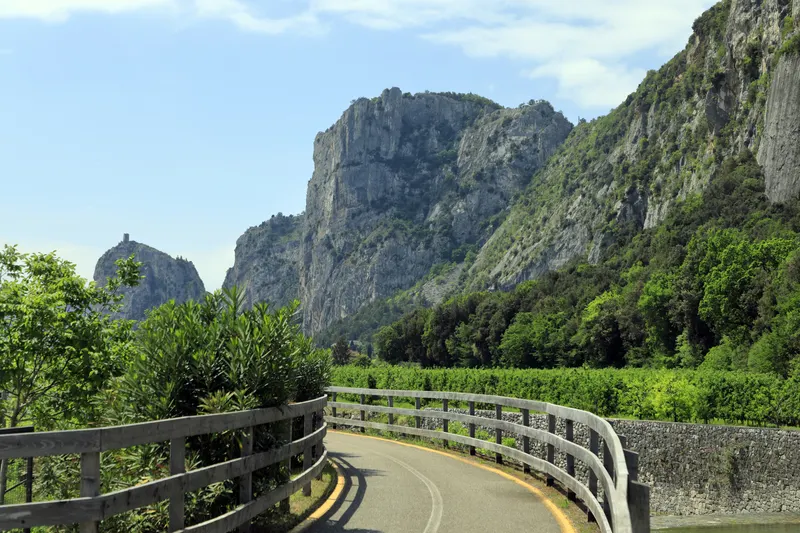

Which via ferratas are of moderate difficulty?
Here you already need to be confident with your set, sure-footed and fit enough for longer climbs.
Via ferrata delle Aquile (Paganella)
Area and start: Cima Paganella, above Andalo and Fai della Paganella. Take the Paganella lifts up, then reach the start via the Sentiero delle Aquile or path 602.
Grade: D. The classic route is graded A to C, the variants D to E.
Elevation gain and times: about 280-350 m. Around 2 hours on the cable, 4-5 hours with the approach and descent.
Season: summer, when the lifts are open.
Why go: from the summit you can see much of Trentino, with the Brenta right in front of you.
Watch out: it is one way only, from the Canalone Battisti to the Trono dell’Aquila. In rain and thunderstorms it is dangerous.
Sentiero delle Bocchette Centrali (Brenta)
Area and start: Brenta Dolomites. Start from the Vallesinella car park (1,513 m) above Madonna di Campiglio and walk up to the Casinei, Brentei and Alimonta huts (2,580 m). The via ferrata begins at the Bocca degli Armi and ends at Rifugio Tosa-Pedrotti.
Grade: PD. Technically not hard, but high and very exposed.
Elevation gain and times: about 400 m on the equipped section and 4-4.5 hours from the Alimonta to the Pedrotti. As a day trip from Vallesinella you are looking at around 1,300 m and 9 hours, so it is better to split it with a night in a hut.
Season: mid June to September, depending on when the huts are open.
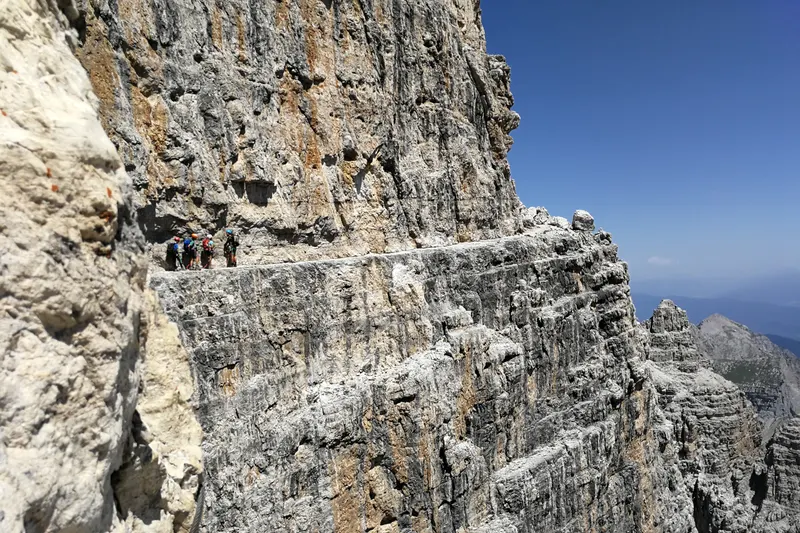
Why go: it is the most famous stretch of the Via delle Bocchette, with airy ledges and a passage close to the Campanile Basso.
Watch out: early in the season, the Sfulmini snowfield and the one below the Bocca di Brenta may call for crampons and an ice axe. Some ledges are only about half a metre wide. Ask at the huts about openings (the Pedrotti stayed closed in summer 2025) and recent rockfalls.

Ferrata dei Finanzieri (Colac, Val di Fassa)
Area and start: Val di Fassa. From Alba di Canazei, take the Ciampac cable car (about 2,150 m) and reach the start in around 30 minutes.
Grade: D. Sources rate it between moderate and difficult. The central section is the hardest.
Elevation gain and times: about 575-600 m, of which around 450 m is equipped. 4-4.5 hours in total. Summit at 2,715 m.
Season: July to September, while the cable car runs.
Why go: it is the most direct choice for a via ferrata in Val di Fassa, finishing on a panoramic summit above 2,700 m.
Watch out: the central section crosses loose, very exposed rock with metal ladders. The descent goes down an equipped scree gully and passes the Forcia Neigra. It has been closed for refurbishment in the past: check the current status with the lift company or the tourist office.
Which are the most demanding via ferratas in Trentino?
These are long or technical routes without easy escape routes. They require experience, fitness and settled weather.
Sentiero delle Bocchette Alte (Brenta)
Area and start: Brenta Dolomites, from Rifugio Tuckett (2,272 m), reached from Vallesinella, to Rifugio Alimonta.
Grade: D. It is the highest and longest section of the Via delle Bocchette.
Elevation gain and times: about 500 m on the equipped section, between 700 and 1,200 m in total depending on the source. Around 4-5 hours from the Tuckett to the Alimonta.
Season: July to September.
Why go: ledges and very long ladders up to about 3,000 m, right in the heart of the group.
Watch out: snow and ice linger in some gullies, and in fog or verglas it becomes serious. Not for anyone on their first via ferratas.
Bolver-Lugli via ferrata (Cimon della Pala)
Area and start: Pale di San Martino, Trentino side. From San Martino di Castrozza take the Colverde gondola, then walk about 45 minutes on path 712 to the start.
Grade: D. Not extreme on any single move, but long, tiring and exposed.
Elevation gain and times: about 1,000 m of ascent, of which 560-700 m is equipped. 6 to 9 hours in total, depending on the descent you choose.
Season: July to September.
Why go: it climbs the south-west face of the Cimon della Pala to the Bivacco Fiamme Gialle, with a wide view over the whole Pale group.
Watch out: the descent towards the Passo del Travignolo crosses a steep snowfield, and with snow you need crampons and an ice axe. The alternative is to carry on towards Cima Vezzana and Rifugio Pedrotti alla Rosetta, which takes longer.
Rino Pisetta via ferrata (Monte Garzolet, Valle dei Laghi)
Area and start: Sarche, in the municipality of Madruzzo, on the Piccolo Dain.
Grade: MD. It is considered one of the hardest via ferratas in the area, with a very vertical start that tests your arms straight away.
Elevation gain and times: about 400 m of via ferrata and 700 m in total, 4-5 hours up plus around 1.5 hours down. Summit at 970 m.
Season: spring and autumn.
Why go: views over Lago di Toblino and the Sarca valley, for people who already have experience on difficult via ferratas.
Watch out: it was closed from 15 October 2025 because of rockfall risk from Monte Garzolet. According to reports collected by via-ferrata.de, the Municipality of Madruzzo lifted the ban from 24 April 2026 after the rock face was scaled: always check before you go.
Ernesto Che Guevara via ferrata (Monte Casale)
Area and start: Pietramurata, in the municipality of Dro. “KS Che Guevara” car park on Via Collungo.
Grade: D. No extreme moves, but it is very long and has no escape routes.
Elevation gain and times: about 1,200 m of equipped route and over 1,400 m to the summit of Monte Casale (1,590 m counting the whole loop). Around 8 hours.
Season: spring and autumn. In summer it is in the sun all day.
Why go: it is the big classic of the Sarca valley for anyone after a long day out, finishing at Rifugio Don Zio Pisoni.
Watch out: it reopened in July 2025 after four years of closure due to rockfall. The descent follows SAT path 427 towards Sarche and then Pietramurata. Bring plenty of water.
When is via ferrata season in Trentino?
It depends on altitude. The via ferratas around Lake Garda and in the Valle dei Laghi are low and at their best in spring and autumn. In summer the humidity and the sun on south-facing walls make even the easiest ones hard work: start at dawn or pick something else.
The Dolomite via ferratas (Brenta, Fassa, Pale) are usually done from July to September, when huts and lifts are open. In June and early July snowfields often remain in shaded gullies. Summer thunderstorms mostly arrive in the afternoon: start early and turn back if the sky closes in, because a steel cable is no place to be in a lightning storm.
What do you need for a via ferrata?
The essential kit is always the same, even for the shortest via ferrata:
- Helmet, on before you reach the wall.
- Harness in the right size.
- Via ferrata set certified to EN 958, with an energy absorber and two karabiners. Check the date and condition of the set.
- Via ferrata gloves, to protect your hands from the cable.
On top of that, bring shoes with a stiff, grippy sole, a waterproof jacket, a warm layer, water, food, a head torch and a charged phone. On high via ferratas with snowfields, such as the Bocchette or the Bolver-Lugli, consider crampons and an ice axe.
One rule applies everywhere: always keep both karabiners clipped in, and only one person on each length of cable between two anchors.
How do you choose the right via ferrata for your level?
- First time: Colodri or Rio Sallagoni, ideally with a mountain guide.
- A few via ferratas under your belt: Burrone Giovanelli, Aquile, Bocchette Centrali (with a night in a hut).
- Experience and fitness: Bocchette Alte, Finanzieri, Bolver-Lugli.
- Experts with strong arms or great stamina: Rino Pisetta and Che Guevara.
Always factor in the way down: on several Trentino via ferratas the descent is as long as the climb, or depends on a lift that may be closed.
If you are also looking for ideas outside the region, read our picks of the best via ferratas in Lombardy and the best via ferratas in Piedmont.
Before you go: what to check
No via ferrata is free of risk, and conditions change all the time. Rockfall, lightning and frost can damage cables and anchors, and municipalities can close a route by order, as happened in recent years to the Rino Pisetta and the Che Guevara.
Before you set off, check path conditions on the SAT website, ask at the huts or the local tourist office and, if in doubt, go with a mountain guide. Do not go alone, and tell someone where you are going.
In an emergency call 112 and, if you have it installed, open GeoResQ to share your position with mountain rescue.
To help you plan your days out and save the via ferratas you want to do, we are building Panorama, the app for mountain lovers. In the meantime, you can find more guides in all the blog guides.
Sources
- Visit Trentino: Via Ferrata Colodri - Colt
- Visit Trentino: Via Ferrata Rio Sallagoni
- Visit Trentino: Via Ferrata Che Guevara - Monte Casale
- Visit Trentino: Bocchette Centrali
- Garda Trentino: Via Ferrata Rio Sallagoni
- Garda Trentino: Via Ferrata Che Guevara
- Garda Trentino: Via Ferrata Colodri - Colt
- Planetmountain: Monte Colodri via ferrata
- Planetmountain: Rio Sallagoni via ferrata
- Planetmountain: Via ferrata delle Aquile
- Planetmountain: Bocchette Centrali
- Planetmountain: Bocchette Alte
- Planetmountain: Via ferrata dei Finanzieri
- Planetmountain: Bolver-Lugli via ferrata
- Planetmountain: Rino Pisetta via ferrata
- Planetmountain: Che Guevara via ferrata
- Paganella: Ferrata delle Aquile
- Dolomiti.it: Le Bocchette Centrali via ferrata
- Dolomiti.it: Ferrata dei Finanzieri
- Wikivoyage: Via delle Bocchette
- Trentino.com: Burrone Giovanelli via ferrata
- CAI Bergamo: Mezzocorona, Giovanelli via ferrata (PDF)
- San Martino di Castrozza: Colverde, Bolver-Lugli via ferrata, Vezzana
- Montagna.tv: The Rio Sallagoni via ferrata
- Montagna.tv: After 4 years the Che Guevara via ferrata reopens
- Via-ferrata.de: reports on the closure and reopening of the Rino Pisetta
- SAT, Società degli Alpinisti Tridentini
- GeoResQ

Plan your via ferrata days with Panorama
Panorama is the app for mountain lovers, coming soon to iPhone, built for people who love via ferratas and bivouac huts. Find out about the project and stay posted on the launch.
Discover Panorama Panorama Sci, free on iPhone and Android.Panorama Sci app · free


FAQ
What is the easiest via ferrata in Trentino?
One of the best for beginners is the Monte Colodri via ferrata at Arco: around 280-300 m of elevation gain and a 2-3 hour loop with a walking descent. Rio Sallagoni at Drena is short too, but it has one harder section. You still need the full kit and, the first time, a mountain guide or an experienced partner.
What is the most beautiful via ferrata in the Brenta Dolomites?
The Sentiero delle Bocchette Centrali is seen as the most famous and spectacular stretch of the Via delle Bocchette, with ledges hanging between the Brenta towers and a passage close to the Campanile Basso. Most people start from Vallesinella, above Madonna di Campiglio, and it pays to spend a night in a mountain hut. Early in the season, snowfields may call for crampons and an ice axe.
When can you do the via ferratas around Lake Garda?
The via ferratas around Arco and in the Valle dei Laghi can be done almost all year, but the best months are spring and autumn. In summer many walls sit in full sun all day and the heat becomes a real risk. In winter snow and ice can appear, which makes progress dangerous.
Do you need a mountain guide for a via ferrata in Trentino?
It is not compulsory, but it is the recommended choice for your first via ferrata, if you are not confident using your lanyard set, and for high mountain routes with snowfields. A guide also judges the conditions on the day. If you already have experience, it still makes sense to check with the SAT, the huts or the tourist office before you go.
How long does the Che Guevara via ferrata take?
Official descriptions give around 8 hours for the full loop, with about 1,200 m of cabled route and more than 1,400 m of elevation gain in total. It is a long, tiring via ferrata with no escape routes, best avoided in high summer because it is in the sun all day. It reopened in July 2025 after a long closure.
What gear do you need for a via ferrata?
The minimum is a helmet, a harness and a via ferrata set certified to EN 958, with an energy absorber and two karabiners. Add gloves, approach shoes or boots with a stiff sole, warm layers and a waterproof. On high via ferratas with snowfields you may need crampons and an ice axe.
What should you do in an emergency on a via ferrata?
Call 112 and, if you have it installed, open the GeoResQ app to send your position to the rescue services. If you can, move to a sheltered spot while staying clipped to the cable. Before you set off, tell someone your route and when you expect to be back.